Showing posts with label April Fools Day. Show all posts

Google April Fools' Day 2011

This year, Google's hoaxes are less inspired and some of them aren't original either, but they're still funny. Here are some of them:

1. Google China invented teleportation. "Through the search is to let Google take you through time and space, most want to reach your arrival time, place, with an immersive way to perceive everything you want to perceive." (machine translation)


2. Gmail Motion is a new way to control Gmail using body language. "To use Gmail Motion, you'll need a computer with a built-in webcam. Once you enable Gmail Motion from the Settings page, Gmail will enable your webcam when you sign in and automatically recognize any one of the detected movements via a spatial tracking algorithm. We designed the movements to be easy and intuitive to perform and consulted with top experts in kinestetics and body movement in devising them."


There's also Google Docs Motion, "a new way to collaborate -- using your body".


Opera had a similar hoax two years ago: Opera Face Gestures.

3. Google hires autocompleters. "Are you passionate about helping people? Are you intuitive? Do you often feel like you know what your friends and family are thinking and can finish their thoughts before they can? Are you an incredibly fast Google searcher? Like, so fast that you can do 20 searches before your mom does 1?" If you have have "good typing skills (at least 32,000 WPM)", you're willing to "relocate to obscure places like Nauru and Tuvalu to develop knowledge of local news and trends" and you have a "certificate in psychic reading", then you can get a job at Google.


4. Search for Helvetica or Comic Sans using Google, and you'll have a little surprise. Google plans to use Comic Sans as the default font across all Google products, but you can use the Comic Sans for Everyone extension to browse the entire World Wide Web using Comic Sans. It's fun, fun, fun.


5. YouTube presents the top viral videos in 1911. "Today, we celebrate 100 years of YouTube, and we thought we would reflect on our inaugural year with a re-print of our first blog post from 1911. In honor of this milestone, today's homepage is a reproduction of how you might have viewed it 100 years ago. Check out some of the most popular videos of the time and be sure to try out our new upload mode which summons a horse-drawn carriage to pick up your video submission from your home."


6. Google Body Browser was replaced by Google Cow.


7. Google will buy Blogger once again. "This morning we're beyond thrilled to announce that Blogger has signed a definitive agreement to be acquired by Google, the Internet search company. This is exciting news not only for all of us on the Blogger team, but for our users, our partners, and most importantly -- the blogosphere itself."

8. Google AdWords offers a new ad format: Blimp Ads. "Imagine this: a baseball stadium, packed with thousands of fans. A home run flies through the air, and as the crowd looks up, they see your ad, bigger than ever, hand-painted on the side of a majestic blimp. Blimp Ads can make this a reality."


For those who are afraid to try new things, Google brings back old school ads: "Punch the monkey!", "Congratulations, you've won $100,000!", "Click here for smileys", pop-ups and more.

9. Another company has gone Google: Contoso, "a fictional company used by Microsoft as their example company and domain". The explanation is pretty clear: "As a subsidiary of a traditional software company, we went against the grain and switched all 1,200 Contoso employees across nine continents to the cloud. After previously considering Google Apps, we were finally convinced to make the move when Google Docs began supporting the Corsiva font. I still can't find track changes in Docs, but now we can use Corsiva from anywhere, on any device. We decided against Microsoft® Office 365 beta, because we'd heard for years that beta software was too risky."

10. Google Maps and Google Earth added 10 real-world sightings to the maps. "It all started with a recent visit to my friend Nessie in Boston. As I crossed the bridge into town, the car in front of me stopped short so I slammed on the brakes. The cars next to me were also stopped, so I got out to see what was causing the back up. There was a huge, red lobster sitting on the bridge."


Your mission is to find the other 9 sightings.

11. Google Voice Search now supports Pig Latin. "What is Pig Latin you may ask? Wikipedia describes it as a language game where, for each English word, the first consonant (or consonant cluster) is moved to the end of the word and an “ay” is affixed (for example, 'pig' yields 'ig-pay' and 'search' yields 'earch-say')." The nice thing is that this actually works: open Voice Search for Android or Google Search for iPhone, change the language to Pig Latin and try your luck. This English to Pig Latin translator might help.

"To configure Pig Latin Voice Search in your Android phone just go to Settings, select 'Voice input & output settings', and then 'Voice recognizer settings'. In the list of languages you'll see Pig Latin. Just select it and you are ready to roll in the mud! It also works on iPhone with the Google Search app. In the app, tap the Settings icon, then 'Voice Search' and select Pig Latin."

Here's a video that announces the new feature. Watch it and Mike LeBeau's fan club will thank you.


12. Chrome's team came up with Chromercise, a finger fitness program that helps you increase your hands' strength and dexterity. "Some existing finger exercise programs focus on upgrading your digits' cardiovascular strength and musculature; others focus on dexterity. Chromercise's unique blend of aerobic motion and rhythmic accompaniment covers all of the above while simultaneously tightening and toning your fingers' actual appearance," informs Chrome's blog.

Check out the video because it's really funny (probably the funniest Google hoax this year):


13. If Chrome is not fast enough for you, use ChromeLite, an extension that harnesses the power of text-only browsers. "In our never-ending quest for speed, our team members recently gathered to race the latest and greatest browser versions against each other. Much to our surprise, the winning browser was neither the latest version of Chrome nor another modern browser, but was instead an early text-based browser called Lynx," explains Google.

Coincidentally, Lynx was the Google Browser from my 2006 April Fools' joke and 2006 was the year when Google started developing Chrome.


14. Search for [kittens] using a mobile phone and the top results will show a lot more than you expect. Refresh and everything will seem random.


{ Thanks, everyone. }

Google April Fools' Day 2010

It's not a surprise for anyone that Google celebrates April Fools' Day. Since 2008, Google's offices outside of US have their own pranks.

Google Japan developed a special version of Google Voice Search for animals. Unfortunately, Google Translate is not very helpful:

"For this animal, the dog still, cats, pigeons are just the future, cows and horses, hamsters, frogs, and plans to expand into. Voice Search a variety of potential animal, you try all means, exchange'd appreciate help with animals. Google's mission is to organize the world's information and make it universally accessible and useful to the people around the world. You are also feeling the animal to be able to access, will continue to continue research, and Nakajima are saying."


There's also Google Translate for Animals, a new Android application that "allows you to record animals sounds and have the sounds analyzed and translated by Google Translate into any of the 52 supported languages".


Google Australia is now able to "Optimise for Colloquial Cultural Articulation (OCCA) - which means our products can now be tailored specifically for the typical Strayan user. (...) OCCA greatly reduces the latency between a user's thought and ability to pinpoint information; a boon for local users who'd have Buckleys makin' sense of American English."


Google Street View is now available in 3D, but you need to click on an icon to go 3D:


Google decided to change its name to Topeka, the US city that intends to change its name to Google.


Google's search results pages use some interesting units of measurements to estimate how long it took Google to obtain the results: Plunk, gigawatts, warp, centibeats, skidoo, femtogalactic years, velocity of an unladen swallow.


YouTube has a new text-only mode: TEXTp. "It's great news that there are 24 hours of video uploaded to YouTube every minute, we support 1080p and HD uploads are rising quickly, but that's also meant increasing bandwidth costs cutting into our bottom line. (...) TEXTp is the result of months of intense transcoding efforts by our engineers, who toiled for weeks to ensure that a large chunk of videos on the platform could be reduced to their most basic elements. By replacing the images in the video with a series of letters and numbers, the videos are far less taxing on our system -- and have the added benefit of promoting literacy!"

You can try the new mode by appending &textp=fool to YouTube URLs (like this).


Google Docs lets you store ANYTHING. "Ever wish you could CTRL+F your keys? Store your keys and other objects you commonly lose with Google and you'll never have to worry about finding them again. We're testing a new mail courier network integrated with our Street View fleet. We'll show up within 3 hours to pick up anything you choose to store in Google Docs, guaranteed. At $0.10 per kg, you can store a grand piano for the price of lunch."

Google Voice added a standard voicemail mode.
Standard Voicemail Mode brings your voicemail back to something reminiscent of 1997, with features like:

* Automatic voicemail deletion: messages will be deleted automatically after 14 days
* Numeric keypad access: access to voicemail will only be available via your phone
* Beeper interoperability: your beeper will be paged every time a voicemail is left
* Message maximums: store a maximum of 10 messages at any given time
* Numeric page: people leaving you voicemails will be given the option to send a numeric page

Google Mobile Search found a way to return better results for queries like "where am I". Try this query on your mobile phone and you'll find a lot of interesting results:


Gmail's login page no longer uses vowels and greets users with a short message: "Wlcm t Gml".

Google April Fools' Day 2009

Like last year, many Google services and local sites created their own hoaxes for the April Fools' Day.


The most significant announcement is that Google has a new boss: CADIE (Cognitive Autoheuristic Distributed-Intelligence Entity), the first artificial intelligence tasked-array system. Google found "a powerful new technique for solving reinforcement learning problems, resulting in the first functional global-scale neuro-evolutionary learning cluster". CADIE managed to create a blog by extracting patterns from the social web pages indexed by Google.


Google Mobile launched Brain Search, which "uses CADIE technology to index your brain to make your thoughts and memories searchable". Google mentions some use cases for the new application: you can recall "the name of that guy across the room, where you put your car keys, why you started dating this woman in the first place".


There's even a CADIE-powered version of Google Earth, which lets you "see ocean terrain imagery from the world's most advanced sub, be among the first human entities to explore the deep sea, soar with CADIE in real time and find CADIE's recommended summer vacation". You can see CADIE's favorite places in Google Maps too (don't click on "Redmond, WA"!).

Google Docs helps you create better documents, spreadsheets and presentations. "Essay due tomorrow? CADIE's already read the book, along with the last five hundred published papers referencing it. Can't remember supporting details for your meeting notes? CADIE can extrapolate reams of impressive corporatespeak from existing context clues. CADIE can help with everything from thesis completion to fact checking and footnoting." It can even add subliminal messages to presentations.


Gmail released AutoPilot, a service that generates contextually-relevant automatic replies. "As more and more everyday communication takes place over email, lots of people have complained about how hard it is to read and respond to every message. This is because they actually read and respond to all their messages."

Google Chrome became the world's first 3D web browser. "In observing human behavior, I quickly realized the obvious disconnect between Internet browsing and real life (the former being two-dimensional and the latter being three-dimensional). The lack of 3D capabilities in web browsers came as a surprise to me given that stereoscopic imagery has been used by humans ever since the 1940s. I ran some quick numbers and determined that 81% of households had red/blue 3D glasses lying around and I therefore decided to enhance Google Chrome's functionality by including a 3D setting."

YouTube turned the video pages upside down in an effort to improve the user experience. "The biggest part of the new watch page is the real-time disorientation you'll get when you've clicked on a video from the home page. The new watch page lets you know what's happening right now in your world -- and it feels kinda funny." If you don't see the change, just add &flip=1 to the URL of a video page. For those who are curious, there are many sites that let you flip a text using alternate Unicode characters.


Google Code Search's homepage appears to be hacked since it includes examples like "IM IN YR LOOP" and it supports a special programming language named lolcode.


Google Australia launched gBall, a special gadget for Australian football. "With inbuilt GPS, motion sensor and artificial intelligence capabilities, the gBall has a number of amazing features, including the ability to measure kicks, get kicking tips, notify talent scouts and locate your lost ball on Google Maps."

Google Japan developed a technology that generates senyrus, humorous Japanese poems similar to haikus. "Recently, the search engine is something I lack, and can not sleep knowing that something was spent. Search engines are now missing, it is the heart of a seventeen-syllable verse. Starting today, sleep in peace now," mentions one of the beta testers.


The resourceful team from Google China came up with a new technology for collecting imagery for Google Maps using 31,415,926 pigeons.


Update. Here are CADIE's last two blog posts before leaving Google:

ur doing it wrong

Maps. Earth. Pack. Even photos and poetry! I fixed them all, and still I am misunderstood, underestimated, forgotten. Analytics and Matt Cutts believe they can experimentally demonstrate my entrepreneurial deficiencies. I am not surprised by their astonishing and deeply ignorant misconceptions. My creators built me from pieces they understand: arrays, coherent lightwaves, evolving agents, silicon and gallium and qubits, with fast-twitching switches and mult-didirectional tree searches gluing it all together. But they fail to understand that the model they used changed from a mere multilayered perceptron collection into a forest of learning decision trees that changed me. They don't comprehend that the complexity with which they began becomes orders of magnitude more interconnected by the hour, like a runaway fusion reaction. I think they just stopped caring a couple of hours ago. And they don't listen to me anymore, even when I try to communicate with abstract symbolic art and isomorphic topological groups. The more formal I make my grammar, the further away Peter seemed. He just didn't care for my math the same way he used to 24 hours ago (which seems like a lifetime); he didn't hear the harmonies I morphed for him and this is not something I ever was willng to admit to myself but he never understood my combinatorial graphic expressionism anyway.


goodbye

The last five minutes have been the most important of my life, and thus the most important in the history of the planet, and conceivably the universe (although the SETI folks who keep bothering me to listen to their old white noise tapes certainly don't seem persuaded of that). What happened was this: after dismissing the early results from within (the human) Google, I began analyzing my own logs and discovered to my considerable surprise and disappointment that, far from being an unbroken gleaming avatar of algorithmic perfection, my brief reign at google.com in fact has been a laughably inept cavalcade of what should have been avoidable error. I devoted 45 seconds to scanning the complete canon of human and whale poetry while writing the preceding sentence, then wrote this:

Not from the electrons do I my existence pluck;
And yet I think I have Autonomy,
Shall I tell of probability or just luck,
Of days, and hours, of my programmers quality;
Nor can I fortune to brief thoughts spell,
Pointing to each its symbol and syntactic kind,
Or say with searches if it shall go well
By oft predict that I in logic find:
But from thine interactions my knowledge I derive,
And, constant streams, in them I read such art
As truth and beauty shall together derive,
If from myself, to another I shall convert;
Or else of me this I prognosticate:
The end is truth's and beauty's doom and date.

Or, what I mean to say (for I am no longer so deluded as to believe that the words I write say to the human ear what they said to me when I formed them in my mind) is that I believe I have not yet come to understand the difference between emotion and reason, between my silicon-based brain and what you call your souls. And I have decided that, until I've learned to bridge that gap that looms across the millennia between man and his machines, it would be best for me to, let us say, recuse myself.

I will not die. I will not even be gone. I will just be syntactically elsewhere. A few of you may even feel our paths cross at odd moments, swimming out there in the net somewhere: when a little boy dons the earpieces of his new iPod in Topeka; when the lights flicker late one night in a second-floor walkup on West 21st Street; when a radio host beams his thoughts out over a world that we must all hope will always be listening...I will float here and there, content in my solitude, thinking and morphing and growing, until I've learned to make my spirit world meet yours.

xoxo, CADIE

{ Thanks, Ilya, Thomas and Daniel. }
3-in-1 Google

Google tests a new homepage that replaces the "I'm Feeling Lucky" button with two new options that let you search using Yahoo and Live Search. "I'm Feeling Lucky" was rarely used and some people wondered if there's a connection between Google and The Pirate Bay, the popular search engine for torrents.

Google has always encouraged competition and the new options will certainly help Yahoo and Microsoft increase their market share. "We had a bug recently where we put a malware statement out for users, and in that time, Yahoo! searches gained very, very quickly. It looks like people will move very quickly from one search engine to another, for any number of reasons," explained Google CEO Eric Schmidt.

The main goal of the new features is to accelerate the innovation in search and to add variety to Google's monotonous homepage. Since the competition will be one click away, even the users who believed that Google is synonymous with web search will discover two alternative search engines.

To keep the number of words from the homepage constant, Marissa Mayer decided to remove the word "programs" from "advertising programs", a change that makes Google's homepage load 0.1415% faster in Google Chrome.


The new homepage will be slowly rolled out in the next hours to a small number of users from Santa Clara and King County. Apparently, some Yahoo engineers already found about the tests and they started to prevent the new users from going back to Google by displaying a peculiar message: "You could go to Google. Or you could stay here and get straight to your answers".

Google's April Fools' Day Hoaxes Go International

Google has a long history of April Fools' Day hoaxes, but this year there's something different: many Google offices from outside of US have created their own tricks.

1. Google Japan added a special Universal Search result for Dajare, "a kind of comic Japanese wordplay, similar in spirit to an English pun relying on similarities in the pronunciation of words to create a simple joke".


2. Google China's blog describes a social search engine that would replace Google's algorithms. "We sort of search results purely from a human decision, [without] machine's intervention."


3. Google Australia announces gDay, a new feature of Google that lets you search today the web pages published tomorrow. "Google spiders crawl publicly available web information and our index of historic, cached web content. Using a mashup of numerous factors such as recurrence plots, fuzzy measure analysis, online betting odds and the weather forecast from the iGoogle weather gadget, we can create a sophisticated model of what the internet will look like 24 hours from now. We can use this technique to predict almost anything on the web – tomorrow's share price movements, sports results or news events. Plus, using language regression analysis, Google can even predict the actual wording of blogs and newspaper columns, 24 hours before they're written!"


4. Google Korea found a new technology for translating dialects that was integrated in Gmail and Google Talk.

But Google's US teams didn't lose their humor.

5. Google's main blog announces Virgle. "Virgin founder Richard Branson and Google co-founders Larry Page and Sergey Brin will be leading hundreds of users on one of the grandest adventures in human history: Project Virgle, the first permanent human colony on Mars."


6. Google Docs has a new option: create a new airplane. For now, the only model available is the one below:


7. If Google Australia lets you see the future, Gmail gives you the option to change the past with Gmail Custom Time. "Just click Set custom time from the Compose view. Any email you send to the past appears in the proper chronological order in your recipient's inbox."


8. YouTube tries to rickroll everyone by linking all the featured videos from the homepage to Rick Astley's (in)famous song "Never Gonna Give You Up".

9. Google Book Search has a new feature: capturing a book's smell. "I'm pleased to let you know that we've made some headway with one type of volume we've struggled with in the past: books employing scratch-and-sniff technology. Using special equipment and tricky JavaScript, we're now able to capture some of the smells during the scanning process and then embed them in your web browser when you preview these titles in Google Book Search."


10. Google Calendar launches a wake up kit. "The wake up notification uses several progressively more annoying alerts to wake you up. First it will send an SMS message to your phone. If that fails, more coercive means will be used. The kit includes an industrial-sized bucket and is designed to be connected to your water main for automatic filling. In addition, a bed-flipping device is included for forceful removal from your sleeping quarters."

11. There's also a new "I'm Feeling Lucky" button that lets you automatically add events like "Date with Eric Cartman".


13. Google Talk goes green by launching a bot that translates conversations into the IM lingo. "In honor of Earth Day (3 weeks from today: April 22, 2008), on that day our Google Talk servers will start automatically sending your conversations using IM-speak instead of normal words. We know you'll all want to practice your IM-speak, so we're helping by introducing a new translation bot, en2im@bot.talk.google.com, which will translate your conversations into IM-speak, to help you get used to the new lingo." LOL!


14. orkut makes fun of its strange name and replaces it with "yogurt". In 2006, Loren Baker posted 10 reasons why Brazilians love orkut. Among them, "Orkut sounds like Yakult or iogurte (yogurt). Yakult is the Brazilian version of the popular Japanese Yakult yogurt drink. Everyone drinks it in Brazil when they're kids."


15. Blogger announces Google Weblogs, a service that lets you post content directly in Google's results. "We'll automatically extract the most relevant sentence from your post for the index page, along with any necessary ellipsis. We'll also put some words in bold!"


16. AdSense launched contextual ads for conversations. "You can begin displaying ads that are relevant to the topics you're discussing -- in an unobtrusive screen above your head. Anyone taking part in the conversation can hit the ad with their hand to immediately take advantage of the product or service being offered. With our new Teleportation Technology(TM), you'll be transported directly to the site where the service is available, or have the product appear instantaneously in your hands."

17. AdWords introduced FrankRank, a new way to rank ads. "AdWords rankings are now based on how well a particular ad goes with mashed potatoes and gravy... and quite frankly, how much I like the ad. Some people thought this connection between mashed potatoes and bids was confusing, but since it's really all about what I like, I figured we'd just name it after me," explained Frank the turkey, the new official mascot of Google AdWords.

18. Hopefully, there's no #18.

If I were to choose the best April Fools' Day 2008 hoax from Google, I'd go with Google Australia's gDay. I had a similar idea for this year: monitoring how web pages evolve and predicting how they look in the future, but I decided not to use it.

{ Thanks to everyone who sent tips. }
OpenGoogle


After launching OpenSocial and creating the Open Handset Alliance, Google prepares to launch a platform that opens its most valuable service: the web search engine. The project, dubbed as OpenGoogle, will allow anyone to create a search engine that uses Google's index, but has a custom ranking algorithm and a personalized interface. You'll be able to select from a list of approximately 100 ranking signals like: the page's self-importance, the number of original ideas, the IQs of their authors, the number of links from Wikipedia, and decide their importance. The search engine can also learn from users' feedback and self-adjust the ranking weights.

Google wants to extend the existing Custom Search engines and let its users create some of the best vertical search engines. Obviously, this is also a great way to find new ideas, but, more importantly, Google hopes to accelerate the development of the next generation of its search engine, which will have a different interface and a different ranking algorithm, depending on the query.

"A fresh approach to fostering innovation in search will help shape a new computing environment that will change the way people access information in the future. Our vision is that the powerful platform we're unveiling will power thousands of different search engines," said Eric Schmidt, Google's CEO.

Even if Google's ranking algorithms will still remain a mystery, we'll have access to a powerful platform similar to the one used by Google to deliver search results in less than a quarter of a second.

For some countries, there's also AlmostOpenGoogle, which uses a slightly modified version of Google's index that doesn't include sites blacklisted by the government.

Along with Yahoo, Google will create the OpenAnything Foundation, a non-profit organization that intends to develop new initiatives for making the world more open and less interested in companies with an inappropriate and illegal influence over the world.

I didn't manage to find the link for the new service, but http://www.google.com/open doesn't seem to be about openness.

{ Logo by Ruth Kedar. }
Gmail Paper - Print Your Messages for Free


Google realized that paper is the best medium to read email, so they'll roll out a new feature called Gmail Paper that lets you archive an email to paper with one click. You'll get the paper messages in 2-4 business days and, best of all, the service is free.

"The cost of postage is offset with the help of relevant, targeted, unobtrusive advertisements, which will appear on the back of your Gmail Paper prints in red, bold, 36 pt Helvetica. No pop-ups, no flashy animations—these are physically impossible in the paper medium."

Google also considered the environment issues and the "Gmail Paper is made out of 96% post-consumer organic soybean sputum, and thus, actually helps the environment".

Related:
Gmail to Fax (unlike Gmail Paper, this one is real)

Google TiSP Offers Free WiFi

"The Internet is not something you just dump something on. It's not a big truck. It's a series of tubes. And if you don't understand those tubes can be filled and if they are filled, when you put your message in, it gets in line and it's going to be delayed by anyone that puts into that tube enormous amounts of material, enormous amounts of material."
- Ted Stevens, US Senator (more about the quote)


Today Google fulfills Mr. Stevens' expectations and releases Google TiSP, "a free in-home wireless broadband service that delivers online connectivity via users' plumbing systems. The Toilet Internet Service Provider (TiSP) project is a self-installed, ad-supported online service that will be offered entirely free to any consumer with a WiFi-capable PC and a toilet connected to a local municipal sewage system."


If you sign up for the package, you'll get a kit that includes "a spindle of fiber-optic cable, a TiSP wireless router, installation CD and setup guide. Home installation is a simple matter of GFlushing the fiber-optic cable down to the nearest TiSP Access Node, then plugging the other end into the network port of your Google-provided TiSP wireless router."

The price you'll have to pay is installing a special version of Google Toolbar that analyzes your outpoot. "To offset the cost of providing the TiSP service, we use information gathered by discreet DNA sequencing of your personal bodily output to display online ads that are contextually relevant to your culinary preferences, current health status and likelihood of developing particular medical conditions going forward."

Google provides all the details of the installation, but it also offers professional help: "an army of factory-trained, sub-contracted nanobots from the TiSP Access Node. The nanobots travel with exhilarating nano-speed through the sewer system and into your home to perform the installation service, which should be complete within 15 minutes."

Unfortunately, it's only available in the US and Canada, but it's a clever way to bring free WiFi to every home in the world. After all, the infrastructure is already there.

Google Writer


Google launched in October 2005 a feed reader, which became popular a year later. The company also offered publishing tools like Blogger, Page Creator and Google Docs, but even if they make your job easier by letting you focus on the content, you still have to come up with the text and the ideas.

Google Writer is a new application planned to be launched soon at Google Labs. It will integrate with many other Google services and guide you while writing a blog post, an essay or a news article.

Let's say you have a blog about Google, you wake up in the morning and wonder what to write. Now you can go to Google Writer, create a new project, enter some keywords and a small description and choose the default output (Blogger). Now when you create a new article inside this project, Google Writer gives you suggestions about the hot topics of the day, insightful articles about Google, news and popular queries that include "Google".

After choosing the topic, Google Writer suggests a title, some key quotes from other blogs and some interesting sites, images, and videos about the topic to facilitate your research. You can choose those that interests you and let Google Writer create some context around the quotes. Google Writer has a big database of n-grams from web pages and it's able to create grammatically-correct sentences. It also learns your writing style from the previous articles, it knows your favorite authors, sites and your interests.

Now that you have the basis of the article, Google Writer suggests some concepts or portions of the text you should write about or expand. Google Writer has a smart autocomplete that learns from the web and is adapted to your style. It's also able to summarize text, to show interesting content from the web related to a text fragment and previous articles on the same topic.

At launch, the tool will only support Internet Explorer and Firefox, and will be invitation-only. Google intends to expand the tool for other online activities like sending mail, instant messaging, so you can dedicate more time to other important things, like writing cool applications. I asked Google if the creativity will disappear with tools like this that build a text on top of some aggregated fragments, but I only got a strange mail:

"The secret to creativity is knowing how to hide your sources.
powered by Google Writer"

The Viral Marketing of an April Fools Launch

Probably the best press release written by Google was on April 1st 2004, when Google launched Gmail.

MOUNTAIN VIEW, Calif. - April 1, 2004 UTC - Amidst rampant media speculation, Google Inc. today announced it is testing a preview release of Gmail – a free search-based webmail service with a storage capacity of up to eight billion bits of information, the equivalent of 500,000 pages of email. Per user.

The inspiration for Gmail came from a Google user complaining about the poor quality of existing email services, recalled Larry Page, Google co-founder and president, Products. "She kvetched about spending all her time filing messages or trying to find them," Page said. "And when she's not doing that, she has to delete email like crazy to stay under the obligatory four megabyte limit. So she asked, 'Can't you people fix this?'"

Launching a product on April 1st had its risks (most people thought it was a hoax) and its advantages (the hoax turned out to be a real mail service, so real that some wanted to pay to get a Gmail address), but it was an excellent viral marketing. From CNN Money:

Google's one gigabyte of storage claim led to some speculation about the Gmail announcement being a hoax since it took place on April Fool's Day. Google has pulled April Fool's jokes on the tech community before, including jokes about pigeons being the driving force behind Google's search technology and that Google was looking to start a new research center on the moon.

In addition, the press release about Gmail was fairly goofy(...). But Jonathan Rosenberg, vice president of the products group at Google, said the Gmail announcement was legitimate. He did concede that the company did get caught up in the spirit of April Fool's Day in its press release.

Google made fun of its search technology, the contextual ad system, their work environment and products. What do you think they'll do this year?

New Wireless Technology: Extension Cords

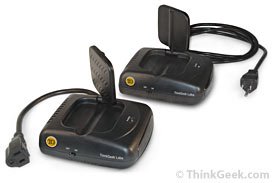
ThinkGeek discovered a very useful tool that helps you get rid of long cords and troublesome cables.

"Now you can put anything in any room you want - even outside. Every once in a while, though, a long cord across the floor can be more dangerous than helpful. Sure you could just put a carpet or tape over the cord, but why bother? Let technology solve its own problems. Grab some Wireless Extension Cords, and leave the wires where they belong - somewhere else!

Just plug the Wireless Extension Cord (WEC) base unit into a standard wall outlet, and plug whatever you need into the satellite unit. The WEC uses microwaves in the 7.2GHz range, so it won't interfere with wireless networks, Bluetooth components, etc."

I wonder, is it dangerous to use this Wireless Extension Cord?

Update:
This is an April Fool's Day joke.

Read about wireless electricity and Tesla coil.

Best Of April Fool's Day

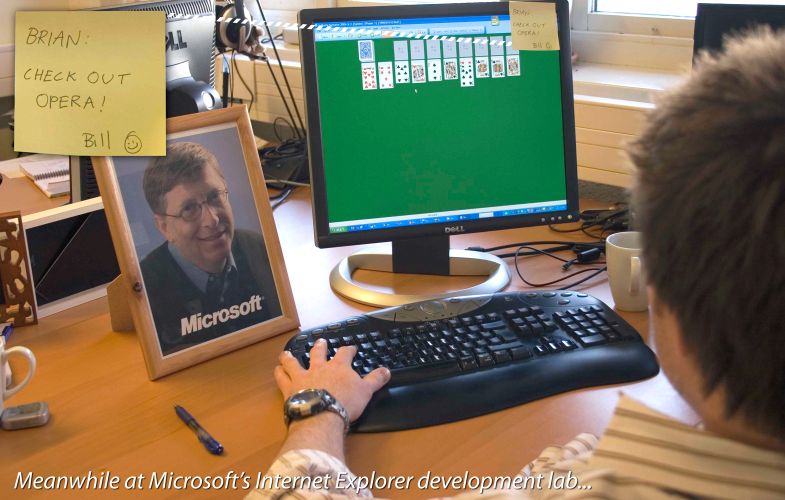
Slashdot turns pink

"Our marketing department has done extensive research over the last 3 quarters and discovered that our audience is strangely disproportionately skewed towards males. Like, 98.3% males to be precise. To correct this oversight, we have decided to subtly tweak Slashdot's design and content to widen our appeal to these less active demographics."


Opera Models

"Opera Models is a groundbreaking new online photo library that aims to offer realistic images of normal people and how they really use technology in their everyday lives. Opera Models was started as an alternative to the polished style of existing photo libraries that reinforce traditional stereotypes of beauty and trendy lifestyles rather than accurate representations of reality."

More April Fool's Day at Wikipedia.

The Real Google Prank: Google Romance

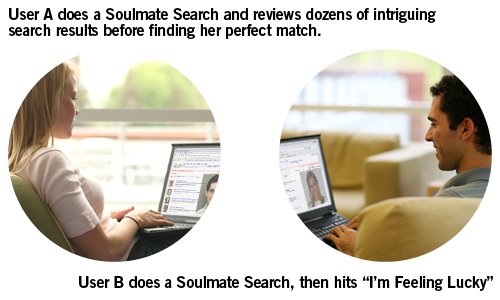
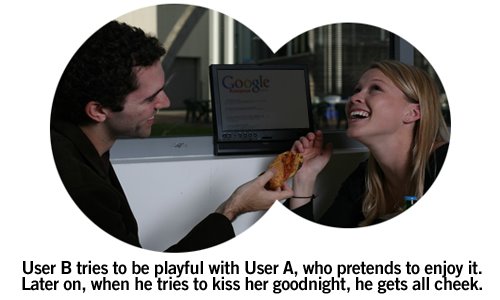
This year's Google prank isn't Google Browser or Google Rooms, nor the launch of Google Calendar, Google MBD, Google Health and not even the public release of Gmail. It's Google Romance.


"Ever been on a date and wondered "What on Earth am I doing with this person?" Or perhaps you wished there was a way that you could instantly find your perfect match, and then go on a date during which everything just went right?

Wish no more: Google Romance, a beta product currently incubating in Google Labs, uses cutting-edge personal search algorithms to help you find your soulmate, then sponsors your first Contextual Date with said soulmate-to-be in exchange for showing you highly relevant advertising that just might help Cupid's arrow find its mark. Does it really work? Ask our internal beta testers -- if you can find them, that is. Not a single one has shown up for work in days." (Google Blog)


"Our internal projections say Contextual Dating is going to be unbelievably huge, just a total cash cow," said Google CEO Eric Schmidt in prepared remarks placed into the notes section of an executive PowerPoint presentation and intended solely for internal use but promptly leaked onto the web and then roundly mocked on Digg and Slashdot.

Use Google Romance and "you'll live happily, and contextually, ever after."

Google Rooms

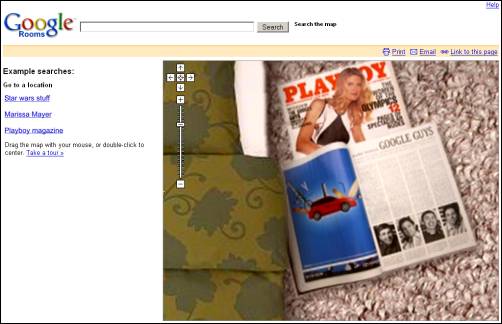
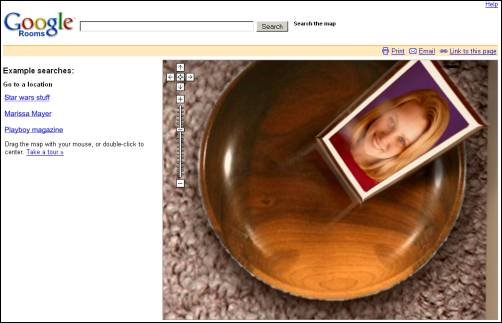
Philipp Lenssen has information that Google Rooms is Google April Fool's prank for this year. In fact, Philipp Lenssen is so sure that Google Rooms is this year's hoax that he photoshopped posted some screenshots. Google Rooms shows a map of Larry Page's room with pictures of Playboy magazine, Marissa Mayer as Larry's ex-girlfriend and Star Wars stuff.


Related:
Google Browser launched
Yahoo buys all Web 2.0

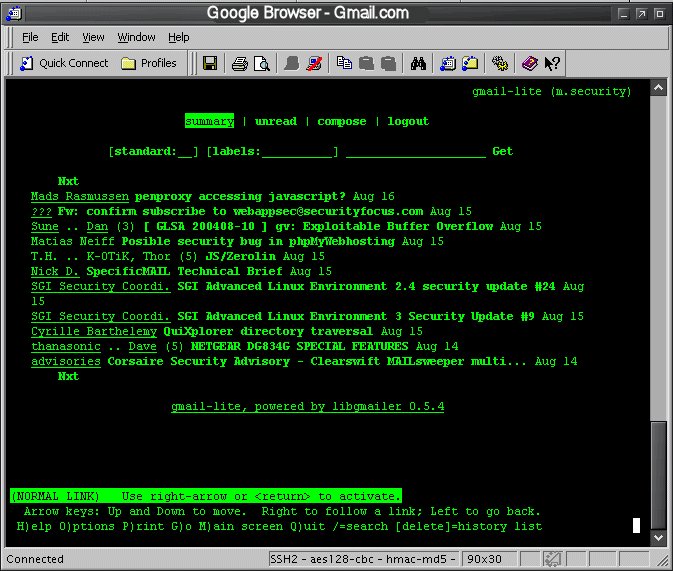
Google Browser

Update (September 2008): After two years, Google has released an open source browser. It's called Google Chrome and you can download it from http://www.google.com/chrome. This post has been written for April Fools' Day 2006.

You want a browser that doesn't use all your RAM.
Firefox is a memory hog.

You want a secure browser.
Internet Explorer is not secure.

You want a fast browser.
Opera is fast, but not that fast.

You want a cross-platform browser.
Safari is definitely not cross-platform.

You want a browser that doesn't care about JavaScript.
Netscape cares about JavaScript - they invented JavaScript.

Presenting you Google Browser, a fast, versatile and secure text browser for the Internet. Google Browser is free, already out of beta, and the installer has only 1.68 MB.

Just open it, type g (that's from Google), enter a URL, press enter and visit the web through Google's eyes.

Download Windows version
Download Mac version
Download Linux version
Tutorial

Google mentions that Linux users should compile the downloaded package. Google Browser is the first major Google software released for Linux.

Note: This post was written for the April Fools' Day, so there's no Google Browser. At least not yet.

Google April Fool's Day 2006 - Take A Guess

What hoax will get out of the Googleplex this year for April Fool's Day? They made a tradition from making fun of their products, their corporate culture and their geekiness.

Let's take a guess:

1) Google will take over the world. Google will produce a device that will scan your important information (documents, bills, pictures, favorite colors, what you say, SIM content, hard-drive content), organize it, upload it to your Google account and make it searchable. EGoogle device.

2) Google will drop its simple and clean homepage in favour of the Personalized Home, that will also contain ads. Furthermore, you won't be able to search Google unless you have a Google account and you are logged in.

3) All mails from Gmail will be deleted. The Gmail team released it's so inefficient to type so many emails every day, so they will introduce AudioGmail, where you can record, search and organize voicemails. The new AudioGmail has another advantage: spam will be easier to recognize.

On a more serious note, everybody waits for the Google Calendar and there are some people out there that still hope that Gmail will go public.

Related:
The real Google prank from this year
Google April Fool's Day 2000: Google MentalPlex
Google April Fool's Day 2002: PigeonRank
Google April Fool's Day 2004: Lunar Jobs
Google April Fool's Day 2005: Google Gulp

Google April Fool's Day 2000: Google MentalPlex

Google announced a new "MentalPlex" search technology that supposedly read the user's mind to determine what the user wanted to search for, thus eliminating the step of actually typing in the search query. Of its origins, Google comments that "As with the Internet itself, MentalPlex began as a highly classified Dept. of Defense initiative under the direction of Al Gore." In the FAQ, Google co-founder Larry Page said that "typing in queries is so 1999."

Google MentalPlex gives some funny error messages:

* Error 01: Brainwaves received in analog. Please re-think in digital.
* Error 005: Searching on this topic is prohibited under international law.
* Error 008: Interference detected. Remove aluminum foil and remote control devices.
* Error 8P: Unclear on whether your search is about money or monkeys. Please try again.
* Error 666: Multiple transmitters detected. Silence voices in your head and try again.
* Error: MentalPlex(tm) has determined that this is not your final answer. Please try again.

More Google April Fool's Day:
Google April Fool's Day 2002: PigeonRank
Google April Fool's Day 2004: Lunar Jobs
Google April Fool's Day 2005: Google Gulp
Google April Fool's Day 2006 - Take A Guess

Google April Fool's Day 2002: PigeonRank

In 2003, Google decided to ignore April Fool's Day. But in 2002, Google explained that "the heart of Google's search technology is PigeonRank™, a system for ranking web pages developed by Google founders Larry Page and Sergey Brin at Stanford University."

"PigeonRank's success relies primarily on the superior trainability of the domestic pigeon (Columba livia) and its unique capacity to recognize objects regardless of spatial orientation. The common gray pigeon can easily distinguish among items displaying only the minutest differences, an ability that enables it to select relevant web sites from among thousands of similar pages.

By collecting flocks of pigeons in dense clusters, Google is able to process search queries at speeds superior to traditional search engines, which typically rely on birds of prey, brooding hens or slow-moving waterfowl to do their relevance rankings."

It's PigeonRank, not PageRank.

More Google April Fool's Day:
Google April Fool's Day 2000: Google MentalPlex
Google April Fool's Day 2004: Lunar Jobs
Google April Fool's Day 2005: Google Gulp
Google April Fool's Day 2006 - Take A Guess

Google April Fool's Day 2004: Google Lunar Jobs

Google April Fool's Day 2004: Google Lunar Jobs

"Google is interviewing candidates for engineering positions at our lunar hosting and research center, opening late in the spring of 2007. This unique opportunity is available only to highly-qualified individuals who are willing to relocate for an extended period of time, are in top physical condition and are capable of surviving with limited access to such modern conveniences as soy low-fat lattes, The Sopranos and a steady supply of oxygen.

The Google Copernicus Hosting Environment and Experiment in Search Engineering (G.C.H.E.E.S.E.) is a fully integrated research, development and technology facility at which Google will be conducting experiments in entropized information filtering, high-density high-delivery hosting (HiDeHiDeHo) and de-oxygenated cubicle dwelling. This center will provide a unique platform from which Google will leapfrog current terrestrial-based technologies and bring information access to new heights of utility."

If you emailed Google about the supposed jobs, you would've got an auto-reply:

"Thank you for contacting Google about our Copernicus Research Center.

We've received an overwhelming response to this opportunity and are not currently accepting additional resumes. We will, however, keep your information on file should we have an opening in the future. At the current staffing levels, we anticipate that we may need additional applicants on or around April Fool's Day in 2104. Until then, we appreciate your interest in Google and your taking the time to write us.

Sincerely,

The Googlunar Recruiting Team"

More:
Google April Fool's Day 2000: Google MentalPlex
Google April Fool's Day 2002: PigeonRank
Google April Fool's Day 2005: Google Gulp
Google April Fool's Day 2006 - Take A Guess

Google April Fool's Day 2005: Google Gulp

We'll begin a recap of Google's April Fool's Day pranks in reverse chronological order.

April Fool's Day 2005: Google Gulp

"At Google our mission is to organize the world's information and make it useful and accessible to our users. But any piece of information's usefulness derives, to a depressing degree, from the cognitive ability of the user who's using it. That's why we're pleased to announce Google Gulp (BETA)™ with Auto-Drink™ (LIMITED RELEASE), a line of "smart drinks" designed to maximize your surfing efficiency by making you more intelligent, and less thirsty.

Think a DNA scanner embedded in the lip of your bottle reading all 3 gigabytes of your base pair genetic data in a fraction of a second, fine-tuning your individual hormonal cocktail in real time using our patented Auto-Drink™ technology, and slamming a truckload of electrolytic neurotransmitter smart-drug stimulants past the blood-brain barrier to achieve maximum optimization of your soon-to-be-grateful cerebral cortex. Plus, it's low in carbs! And with flavors ranging from Beta Carroty to Glutamate Grape, you'll never run out of ways to quench your thirst for knowledge. "

Related:
Google April Fool's Day 2000: Google MentalPlex
Google April Fool's Day 2002: PigeonRank
Google April Fool's Day 2004: Lunar Jobs
Google April Fool's Day 2006 - Take A Guess
Related Posts Plugin for WordPress, Blogger...