Showing posts with label Social. Show all posts

Better Embedding Code for Google +1 Buttons

Google wants to see a +1 button on each Web page, but many people hate embedding widgets and buttons because they clutter pages and add hundreds of milliseconds to the page loading time.

Google is obsessed with speed and performance, but it didn't do a good job at optimizing the code for embedding +1 buttons. As Aaron Peters explains, Google's code blocks page loading if you place it inside the <head> tag, so it's better to place it before you close the <body> tag. An even better idea is to load the Google +1 script in a non-blocking way, just like Google did with Google Analytics, AdSense and Google Related Links.

Aaron also noticed that the JavaScript code is not minified, browsers can only cache the JavaScript file for 6 minutes and there's a mistake in the code from this page: "http" should be replaced with "https" to avoid an unnecessary redirect.

Here's a better embedding code suggested by Aaron:

<!-- Place this tag just before your close body tag -->
<script>
(function(d, t) {
var g = d.createElement(t),
s = d.getElementsByTagName(t)[0];
g.async = true;
g.src = 'https://apis.google.com/js/plusone.js';
s.parentNode.insertBefore(g, s);
})(document, 'script');
</script>

<!-- Place this tag where you want the +1 button to render -->
<g:plusone></g:plusone>

Apparently, the code doesn't work in Blogger by default. There's a workaround, but you shouldn't use it if you aren't familiar with HTML and editing Blogger's template. Basically you can replace <b:include data='blog' name='all-head-content'/> with the code generated by Blogger ("view source" is your friend), then delete: <meta content='blogger' name='generator'/>.

As Google explains, "most browsers will load the code in parallel with other scripts on the page, thus reducing the web page load time".

Google +1 Button for Websites

When Google launched the +1 button for search results back in March, many people wondered why the button couldn't be added to any site. Now you can add the button to your site using a simple JavaScript code, just like the buttons for Twitter and Facebook.

"+1 is as simple on the rest of the web as it is on Google search. With a single click you can recommend that raincoat, news article or favorite sci-fi movie to friends, contacts and the rest of the world. The next time your connections search, they could see your +1's directly in their search results, helping them find your recommendations when they're most useful," explains Google.


The button can be customized: you can hide the number of +1's, choose a different button size or explicitly load the button. "By placing the tag at the bottom of the document, just before the body close tag, you may improve the loading speed of the page," suggests Google.

Right now, very few websites include Google's +1 button, so installing a browser extension could be a better option. Unfortunately, Google hasn't released yet a +1 extension.

More Google Social Search Results

When Social Search was released, Google displayed a small OneBox at the bottom of the first search results page that included relevant pages shared by your friends. A few weeks ago, Google started to show social search results anywhere on the page.

If that wasn't enough, Google added huge lists of social search results at the bottom of the second, third and fourth page of results. After the ten regular results, Google shows other ten results from your social circle. Sometimes Google's social results are useful, but that's not always the case. For example, a search for [Firefox 4] returns many outdated pages about Firefox.


It's interesting to notice that social search results need more space than the regular results:

Google +1

Google +1 is yet another attempt to make Google more social. It's Google's version of the Facebook "likes", a simple feature that's very powerful because it's part of a social network.

Google will show +1 buttons next to all search results and ads, while encouraging other sites to include the buttons. All +1's are public and they're tied to Google Profiles. The goal is to use this data to personalize search results and ads by recommending sites +1'd by your friends. Google Social Search already does this, but there's no support for Facebook likes, so Google had to come up with a substitute.

"+1 is the digital shorthand for 'this is pretty cool.' To recommend something, all you have to do is click +1 on a webpage or ad you find useful. These +1's will then start appearing in Google's search results," explains Google.


This feature is slowly rolled out to Google.com, but you can try it by enabling the +1 search experiment.


One thing is clear: Google won't have to translate "+1" when it will localize the service, but it will have a hard time translating "+1's", "+1'd" and other cryptic constructs. Google +1's URLs already look weird (here's the homepage: http://www.google.com/+1).

Your +1's are listed in a profile tab, where you can manage them. There's also a page that lets you disable personalizing Google ads using +1's and other information from your Google profile.

Google now has the most important pieces of a social network (profiles, activity stream, likes, apps), but there's still no social network, no magic "glue" that connects the existing pieces. As Danny Sullivan explains, the "+1 social network" is made up of your Google Talk friends, the people from Gmail's "My contacts" group and the people you follow in Google Reader and Google Buzz, but you'll soon be able to connect other services like Twitter and Flickr. It's actually a meta social network, an artificial service that won't have too many enthusiastic users, just like Friend Connect.

Google's Navigation Bar Links to Your Google Profile

Google's new navigation bar started to link to the profile pages. Click on your name at the top of a Google page and you'll notice that you can quickly access your profile. If you don't have a profile, Google includes a link to a page that lets you create an account.


Another change is that Google Profiles include a new tab for Picasa Web Albums, but it's not enabled by default and it's not available if you don't link your Google Profile with Picasa Web. "Your profile and scrapbook photos already make it easier for people to get to know you, but we want to do more to help you showcase your favorite pics. By choosing to show the PicasaWeb tab, you will enable visitors to see your public albums. Private albums will remain visible to only the people you've shared them with directly."


{ Thanks, Stefan. }

Google and the Value of Social Networking (Part 3)

Paul Buchheit, the ex-Googler behind Gmail and a former Facebook employee, answered a question about the rivalry between Google and Facebook.
There is an interesting competitive element there because Facebook is growing very fast, and obviously, Google would like to compete in the social-networking space. They have finally realized its importance, and they are finding themselves, maybe for the first time, with the realization that there is someone who is way, way ahead of them.

There was a moment with Microsoft that they assumed that Google was like, "Well, yeah, search isn't that important. And if it does become important, we'll just hire some people and we'll take over." They kind of thought it was something they could win really easily, and they underestimated the difficulty of it. I kind of feel like Google may have reached that same moment with social networking, where they realized, A, it's important, and B, it's really hard to win.

Paul is not the first ex-Googler who thinks that Google didn't understand the importance of social networking. Another former Googler said that "there is some belief at Google that their DNA is not perfectly suited to build social products", while Aaron Iba, who worked on the Orkut team, noticed that "social networking [was viewed] as a frivolous form of entertainment rather than a real utility".

{ via Avinash }

Google Social Search, a Recommendation Engine

Google Social Search is not a new feature, but it wasn't that important until now. Google used to display at the bottom of the search results page a few links to pages created or recommended by your friends and social connections. The feature automatically obtained data from Google Reader, Google Buzz, Gmail Contacts, Twitter and other sites linked from your Google profile.

Google's blog announced that Social Search will be used to enhance Google results and will become a ranking signal. Social Search borrowed Hotpot's interface that annotates results with messages like "Dan rated this place 5 stars", so you can see why a page ranks so high.


"Social search results will now be mixed throughout your results based on their relevance (in the past they only appeared at the bottom). This means you'll start seeing more from people like co-workers and friends, with annotations below the results they've shared or created. So if you're thinking about climbing Mt. Kilimanjaro and your colleague Matt has written a blog post about his own experience, then we'll bump up that post with a note and a picture," explains Google.

Sometimes a web page is more valuable if it has been recommended by a friend because you probably trust that person. Google uses data from your Google account or publicly available data to generate a list of social connections, but you can't highlight the people you trust or customize the list. What you can do is to add links to your Google profile and to import data that's not publicly available. The Google Accounts page will include an option that lets connect your accounts from services like LinkedIn and import your contacts.

Google Places for iPhone

Why build a local search app for iPhone when the Maps app already lets you find businesses and local attractions? Apple's Maps app doesn't use all the information that's available about businesses, doesn't show photos, reviews and other details. That's one of the reasons why Google decided to build an iPhone app called Google Places.

"We realize the importance of finding places you'll love while you're out and about, no matter what mobile device you use. And Places with Hotpot not only helps you find places near where you are, it gives you the best places to go for you by personalizing your search results," explains Google.

The application integrates with Google Hotpot and uses your ratings and your friends' ratings to recommend other places. Google Places encourages users to rate businesses and to post reviews in order to get better search results and that's an interesting proposition. What's missing from the app is a list of business you've previously rated and the Hotpot feed that's now available on Google Maps.


Geo services are one of the key Google assets and it's very likely that Google will use them to create a stealth social network. Google Maps is probably the best mapping service and one of the most popular local search engines, so the social layer will have an important user base. Unlike Google Buzz, Hotpot doesn't have privacy issues yet and it doesn't feel like a different app because it's properly integrated with Google Maps.

Google Places for iOS can be installed from the Apple App Store and it's only available in English.

Most Shared Section in Google News

Google News has a new section that lists the most shared articles. It's not clear if Google counts the number of people who used the sharing feature from Google News or tracks the references from Twitter and other social sites, but Google's chart is not very reliable. When I started to write this post, the most popular news article was a story about Google's Groupon acquisition that has been shared by 2,189 people.


15 minutes later, the most popular article was a NASA press release shared by 10,893 people.


{ Thanks, Cougar Abugado. }

Google Hotpot: Local Recommendations from Friends

Google launched a new service called Hotpot that promises to improve local search results using recommendations from your friends. "With Hotpot, we're making local search results for places on Google more personal, relevant and trustworthy," explains Google.

To get useful recommendations, you first need to share your ratings with your friends, but Hotpot's main problem is that it's not connected to any social network. When you first visit the service, Google asks you to enter a nickname for Google Places and to send invitations to some of your Gmail contacts. You're creating a new contacts group in a standalone application, instead of using an existing list of friends.


Google Hotpot is mostly useful when you try to find a place using Google's local search engine. Google personalizes the results by promoting the local businesses recommended by your friends.


Unfortunately, Hotpot is a completely unnecessary service, considering that you could already review places and that the reviews were already public. Google Maps was one of the first Google services that integrated with Google Profiles, so sharing your ratings with your friends was the obvious next step. Google Reader did that in 2007, but many users were unhappy because their favorite posts were automatically shared with Google Talk contacts and some of those contacts were automatically added by Google. Two years later, Google Buzz made the same mistake by automatically subscribing users to the list of Google Talk friends.

Google will never develop successful social services until users are able to create a list of friends that could be used in multiple services. To avoid the backslash from the Google Buzz launch, Google Hotpot asks you to manually add friends, but maintaining separate lists of friends is cumbersome.

Google and the Value of Social Networking (Part 2)

New York Times has another article about Google's efforts to create successful social services. A former Google employee confirms what Aaron Iba and Peter Norvig have previously said: Google didn't understand the value of social networking.
There is some belief at Google that their DNA is not perfectly suited to build social products, and it's a quite controversial topic internally. The part of social that's about stalking people, sharing photos, looking cool — it's mentally foreign to engineers. All those little details are subtle and sometimes missed, especially by technical people who are brought up in a very utilitarian company.

Now that social networks have become very popular, Google realized there's a lot of value in sharing information with your friends. Search results can include web pages recommended by your friends, ads can be better targeted based on your social profile and web apps like Google Latitude or Google Buzz can be more useful.

Eric Schmidt said that Google will add a social layer to its existent services and it won't create a social network like Facebook. Google also acquired start-ups that created apps for social networks (Slide, Jambool). "In a rare move for an outsider, Google has named Max Levchin, former CEO of Slide and cofounder of PayPal, a vice president of engineering," reported VentureBeat two months ago.

Google will have to learn to create social services, but it won't be easy and Google's culture might have to change. Here's what Max Levchin said a few months before becoming Google VP:
For some strange reason, in the last few years, the industry, or the press that covers the industry, has come to glorify failure. I think it's completely wrong. Failure is not good.

For Google, failure is always an option, especially when it comes to social networking.

Google Me: a Social Upgrade, Not a New Service

Eric Schmidt said at the Google Zeitgeist conference that Google will add social features to the existing services, but it won't launch a standalone product to compete with Facebook.

"We're trying to take Google's core products and add a social component. If you think about it, it's obvious. With your permission, knowing more about who your friends are, we can provide more tailored recommendations. Search quality can get better. Everybody has convinced themselves that there's some huge project about to get announced next week. And I can assure you that's not the case," said Eric Schmidt, according to MSNBC.

Google's CEO also said that "the best thing that would happen is for Facebook to open up its data. Failing that, there are other ways to get that information."

Wall Street Journal speculates that YouTube is one of the services that will add more social features. For example, you'll be able to see when a video is watched by many of your friends.

Ever since Google Profiles has been launched, back in 2007, Google added social features to services like Google Maps, Google Reader, iGoogle, but failed to create a compelling interface that integrates all these features. The most important attempt to integrate Google's social services is Google Buzz and Google should focus on improving Buzz, create a standalone interface for people that don't use Gmail, adding more privacy features, introducing reciprocal friendship and building a meaningful social graph.

Until Google users can answer the question: "who are my Google friends?", Google will never be able to develop successful social services. Are they the Google Chat buddies, the contacts from the Friends group, the people you follow in Google Buzz? Google ignored for many years Gmail's contact manager and automatically added entries to the address book when you replied to Gmail messages. The problem was only solved when Google launched a business version of Gmail and users wanted to sync their contacts. Now Google will have to solve the friendship issue.

Google Buys SocialDeck

Google acquired yet another social gaming company: SocialDeck. The start-up had an interesting idea: creating a platform for playing games on any device. "SocialDeck was founded in 2008 with the vision of enabling 'anywhere, anytime, anyone' gaming. The company has launched several titles for the iPhone, Facebook, and BlackBerry using its social gaming platform technology, which enables simultaneous game play across multiple mobile devices and social networks," explains SocialDeck's site.

It should be obvious that Google doesn't buy companies like SocialDeck to develop games. Most likely, Google wants to create a platform for social gaming that will enable users to play the same game on an Android device, on an iPhone, on a computer, on a Chrome OS tablet, in Google Me or any other social network that uses Google's platform.

Here's an overview of SocialDeck's gaming platform:


{ via Inside Social Games }

Orkut Lets You Communicate with Groups of Friends

Orkut, Google's social network that has a lot of users in Brazil and India, has received a major update. Groups of friends are more visible and you can send messages to the members of a group directly from Orkut's homepage. Orkut also updated search results pages and application pages, while testing a new platform for communities.


There are a lot of changes and it will be interesting to see if Google tests these features in Orkut before launching Google Me, a social network that will compete with Facebook.

One of the major changes in Orkut is the focus on groups. "You love your grandma and you're friends with your boss, but that doesn't mean you want them both seeing the conversation you're having with your friends the day after a party. With orkut, you can now build separate groups of your friends reflecting how you interact with them in real life." This is one of the ideas from "The Real Life Social Network", a presentation by Paul Adams, Senior User Experience Researcher at Google.


Google's Rahul Kulkarni mentioned last year that Orkut will change a lot. "The new Orkut adopts the latest Google Web Toolkit platform and includes features such as built-in simultaneous chat, photo tagging with automatic face detection and private sharing of photo albums including new safety features. This is the beginning of a new direction for Orkut, where users will be able to increasingly share and communicate with groups of friends from their lives."

Google Buys Slide

Google announced that it has acquired Slide, a start-up that develops social apps. TechCrunch reports that Google paid $228 million for Slide, after investing in Zynga, one of Slide's competitors.

"For Google, the web is about people, and we're working to develop open, transparent and interesting (and fun!) ways to allow our users to take full advantage of how technology can bring them closer to friends and family and provide useful information just for them. Slide has already created compelling social experiences for tens of millions of people across many platforms, and we've already built strong social elements into products like Gmail, Docs, Blogger, Picasa and YouTube. As the Slide team joins Google, we'll be investing even more to make Google services socially aware and expand these capabilities for our users across the web."

It's obvious that Google plans to launch a social service to compete with Facebook, but it's not clear why it would buy a company that develops apps like SuperPoke, SuperPoke Pets or FunSpace. Maybe for Slide's engineering talent, Slide's valuable analytics data or maybe because it couldn't buy Zynga.


Social networks and online games account for about 33% of the time spent online in the US, according to a Nielsen study. Tom Chatfield, the author of Fun Inc: Why Games Are The 21st Century's Most Serious Business, thinks that social games aren't a fad: "People realised that a social platform like Facebook gives people ways to show off to, or compete with, their friends. It's so much more engaging to do something with people you know than to do it with strangers. You can cheat if you're playing online with strangers, but playing with friends is an incentive to be fair, and that brings the emotional rewards of competition."

Since Facebook has the Internet's main social graph and stores data about more than 500 million users, all the cool social apps integrate with Facebook. In the future, every web application will have a social component, which will probably powered by Facebook, a closed social network that traps user data.

OpenSocial is a Google project whose goal was to create social apps that work in any social network. FriendConnect was designed to transform any site in an OpenSocial container. Buzz is the epitome of openness, by embracing open standards and allowing anyone to access the firehose, which includes public activity from every Buzz user. Unfortunately, these projects haven't been very successful, so Google will have to build a social network on top of OpenSocial, Google Buzz and Google Profiles. The project is crucial for the future of Google search, Google ads, Google's web apps and maybe more than that.

Peter Norvig says in an interview that Google's biggest mistake was ignoring social networking.

"I can't speak for the whole company, but I guess not embracing the social aspects [was Google's biggest mistakes]. Facebook came along and has been very successful, and I may have dismissed that early on. There was this initial feeling of, 'Well, this is about real, valid information, and Facebook is more about celebrity gossip or something.' I think I missed the fact that there is real importance to having a social network and getting these recommendations from friends. I might have been too focused on getting the facts and figures—to answer a query such as 'What digital camera should I buy?' with the best reviews and facts, when some people might prefer to know 'Oh, my friend Sally got that one; I'll just get the same thing.' Maybe something isn't the right answer just because your friends like it, but there is something useful there, and that's a factor we have to weigh in along with the others."

A New Social Google Service?

There's a lot of speculation about a new Google service called "Google Me" that is supposed to compete with Facebook. Most likely, the service will expand the already existing profiles and activity streams, while adding support for social apps.

Wall Street Journal reports that Google has been in discussion with companies that develop social games for Facebook. "Google is in talks with several makers of popular online games as it seeks to develop a broader social-networking service that could compete with Facebook, according to people familiar with the matter."

Google's CEO, Eric Schmidt, said that "the world doesn't need a copy of the same thing", suggesting that Google won't try to imitate Facebook. It's clear that Google hasn't anticipated Facebook's success, placed losing bets and efforts like OpenSocial couldn't save Facebook's competitors from extinction.

Now that people spend a lot of time online using Facebook and find information filtered by their friends, even Google's search engine can become less useful. A lot of information is trapped inside Facebook: social connections, status messages, discussions and Google can't use most of the data to improve the relevance of search results.

Google has been more concerned with creating open standards for building social apps, for delivering real-time notifications, for public preferences, aggregating social graph data, but it didn't manage to build a coherent user experience that links all these pieces.

Google and the Value of Social Networking

Many people wonder why Google didn't manage to build successful social services. Orkut's success is limited to Brazil and India, iGoogle's social gadgets aren't popular, Friend Connect isn't widely used, Google Buzz has a lot of potential, but not much success.

Aaron Iba, a former Google employee, thinks that Google failed to realize the value of social networking:
I worked at Google in 2005 and briefly on the Orkut team. I encountered an environment that viewed social networking as a frivolous form of entertainment rather than a real utility, and I'm pretty sure this viewpoint was shared all the way up the chain of command to the founders.

At that time, hardly anyone at Google actually used Facebook, so they just didn't understand what people were getting out of social networking products. Incredibly, many people on the Orkut team did not use their own product (let alone Facebook) outside of work. By contrast, everyone I know who worked at Facebook was a passionate user of that product.

Ultimately, I believe Google didn't succeed at social networking because of this widespread misunderstanding of the value in social networking products.

Google's attempts to build social services were unsuccessful because they didn't add a lot of value. Paul Adams, user experience researcher at Google, thinks that "the social web is not a fad, and it's not going away. It's not an add-on to the web as we know it today. It's a fundamental change, a re-architecture, and in hindsight its evolution is obvious. The emergence of the social web is simply our online world catching up with our offline world."

Google Buys Aardvark

Google acquired Aardvark, a start-up that helps you find answers to your questions in an interesting way.

"Aardvark is a new kind of tool that lets you tap into the knowledge and experience of friends and friends-of-friends. Send Aardvark a question (from the web, IM, email, Twitter, or iPhone) and you'll get a quick, helpful response from someone with the right knowledge and experience to help," explains the FAQ page.

Instead of sending a question to all your Twitter followers or Facebook friends, you could use Aardvark and send the question to those that have the expertise to answer it. When you sign up for Aardvark, you need to enter your main interests. Aardvark automatically tags questions, tries to find the users that could answer the questions and sends them the questions.

Aardvark uses a lot of signals to determine the people that receive your question: related topics in profiles, how you're connected to people, who you trust, your history of training Aardvark, people who share your favorites (for taste-related questions), people in the right location (for location-related questions). It's quite clever and it's very similar to Google's ranking algorithms. Instead of matching a query to the best search results, Aardvark matches a question to the best people that can answer it.

"On average, we have to contact eight people to get two who are willing and online. But we look at thousands in order to build the list of the top prospects," explains Nicholas Chim, a senior engineer at Aardvark.


This is the future of social search and Google is already in the process of integrating social search with standard search results. For now, Google indexes existing user-generated content from your social connections, but it's not difficult to anticipate that Google Social Search will generate new content.

"When you need an answer to a very specific question, sometimes the information just isn't online in one simple place. For example, let's say you want to know if there's snow on Skyline Boulevard on a given day or the best time of year to plant beans in the Bay Area. You might find weather reports and planting guides on many different sites, but for these kinds of questions, a person with the right expertise can be a lot more useful than a webpage," mentions Google's blog.

Aardvark's acquisition is special for many reasons: Aardvark's chief executive is a former Google employee, the service is still available even if it was acquired by Google and it's the first acquisition directly added to Google Labs.

"Aardvark is meant for tips, advice, opinions, and recommendations that pull knowledge from a trusted network." Here's an example of conversation:


A Google Labs user posted a way to find if it's a good idea to ask a question using Aardvark:

"Ask subjective questions that are interesting for someone to answer and rich in context. My rule of thumb is to ask anything that could be better answered if I gave a second sentence of context. If no second sentence would really help get me a better answer (like "who was the 40th president?") then it's probably a better question for Google."

It will be interesting to see how Aardvark integrates with Google Buzz, Google Talk and Google Search.

Google Social Search

Last week, Marissa Mayer announced at the Web 2.0 Summit a new experimental feature that will improve search results with web pages created by your social connections.

"Due to the ever-increasing popularity of social networks, we've been thinking about how your social network could influence and improve your search results. Social Search does just that by surfacing content in your search results that is written by your friends or people you follow. That way, you get the best resources from the web overall, plus the best results (blogs, reviews, travelogues) that are relevant to you, since they were written by people you know. Social Search will be launching soon on Google Experimental and Google Labs," explained Marissa Mayer.

The feature is opt-in and it's strongly connected to Google Profiles and Gmail. For example, if you add a link to your Twitter page to your Google profile, Google will find the people you follow and the content they produce: blogs, photo albums, videos, reviews. If your query returns useful results from your social connections, Google will display the results at the bottom of the search results pages.


In an interview from 2008, Marissa Mayer said that social search is very important. "We believe social search is any search aided by a social interaction or a social connection… Social search happens every day. When you ask a friend "what movies are good to go see?" or "where should we go to dinner?", you are doing a verbal social search. You're trying to leverage that social connection to try and get a piece of information that would be better than what you'd come up with on your own. (...) I think one way Google will be better is in understanding more about you and understanding more about your social context: Who your friends are, what you like to do, where you are. Given how things have transitioned online – everything from travel planning to purchasing books — my belief is that a lot of those physical questions we ask now will ultimately begin to transition to the online medium and that social context will be leveraged there."

Update: Google Social Search is now available in Google Labs. Join the first experiment and then type your query at google.com. If you don't see an OneBox at the bottom of the search results pages, click on "Search Options" and select "Social" to restrict the results to your social circle.


A help center page explains who is in your social circle:

* People you're connected to through social services, such as Twitter and FriendFeed, that you've listed in your Google profile.
* People in your Gmail (or Google Talk) chat list.
* People in your Friends, Family, and Coworkers contact groups for Google.

For some reason, Google decided to arbitrarily expand your social circle to people you don't even know. "If someone you don't know shows up in your social search results, it's likely that they're connected to someone you do know. Social Search includes results from public connections of your immediate social circle, since there's a high likelihood that you know them as well. For example, if you're following someone on Twitter, and that person is following five other people, those five other people are also included in your social circle."

Social Search also includes your Google Reader subscriptions, so it's now easier to search Google Reader.


{ via Search Engine Roundtable and Google Blog }

Social iGoogle Tested in Australia

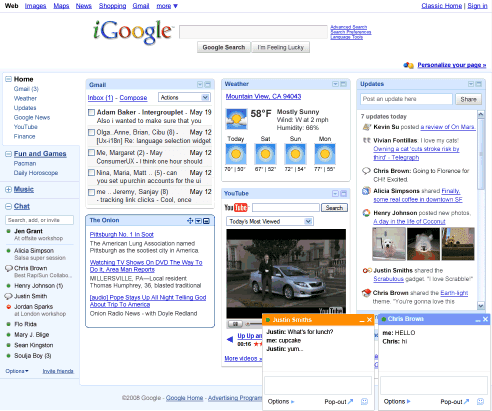
The main reason for one of the most hated Google redesigns, the famous iGoogle update from 2008, was to transform gadgets into social web applications. The visible changes didn't make the upgrade compelling, since most users only saw a sidebar that took away some space from an already crowded homepage. Some gadgets could be maximized in a canvas view to display even more information, but not many gadgets used this opportunity in a meaningful way.


Google didn't offer an option to switch back to the classic iGoogle interface, but you can still find it if you go to http://www.google.com/ig?hl=all and in some local versions of iGoogle.

The second step of the iGoogle update is to make it more social by converting iGoogle into an OpenSocial container. That means you'll be able to add to iGoogle applications that are already available in social networks like MySpace, Orkut, LinkedIn. The main problem is that iGoogle is not a social network and the "friendship" concept is vague in the GoogleLand.

Google Australia announces that the local version of iGoogle has already added the social features:

"Starting this week, we're rolling out some new social gadgets for iGoogle to all Australian users. Not only can you continue to do all the things you love to do on your homepage, but you now have the option to share all kinds of information, play games and collaborate with your friends too. (...) Your current gadgets will continue to work normally and you don't have to take advantage of the social gadgets if you decide it doesn't fit your interest. But by adding and enabling social gadgets, you'll be able to have an even deeper, interactive experience with your gadgets when you share them with friends."

But who are these Google friends? The answer is pretty simple: the contacts from the built-in Friends group.

"Friends is a group to help you organize your contacts. You can move contacts in and out of this group at any time, and this is the only group of people who can see your updates and with whom you can share social gadgets and social gadget activities. Similarly, you can see someone else's updates or social gadget activities only if they have included you in their Friends group."

For Google, friendship is a one-way concept. You don't have to invite other people to become your friends: just add them to the built-in Friends group and they'll be able "to see what you share or do in social gadgets through the gadgets themselves, or through a new feed of information called Updates, a way to see what your friends are doing on iGoogle".

An example of social-enabled gadget is "Social Photos", which shows the latest photos uploaded to Picasa Web and Flickr by your friends.


Other examples include: the "Timeline" gadget, that lets you share what you are doing and see your friends' status messages on a timeline; puzzles and games like NY Times Crossword, chess, trivia; collaborative gadgets like ToDo List.

The features will be rolled out this week at iGoogle Australia, but you can also try them in the iGoogle Developer Sandbox. Developers can find more about iGoogle's social gadgets by visiting this page.
Related Posts Plugin for WordPress, Blogger...