Showing posts with label iGoogle. Show all posts

Google Tests a New Layout for iGoogle

There's a new iGoogle interface that's only available to a small number of users. Google dropped the rounded corners and only shows the controls when you mouse over a gadget. Another change is that gadgets have a small icon next to the title.

Avery M., who sent this tip, noticed the new interface when visiting iGoogle Japan, but that could be a coincidence.


{ Thanks, Avery. }

Google Classic Plus

The new feature that lets you add a background image to Google's homepage has a name reminiscent of Microsoft: "classic plus". When you click on the link to iGoogle, there's an option to switch to the classic homepage. Now the classic homepage has an important feature that was only available in iGoogle: themes.


It will be interesting to see if Google adds more features from iGoogle to the "classic plus" homepage. Google could add some simplified gadgets that show if you have new messages in your Gmail inbox, new events in your Google Calendar agenda, gadgets for weather and news. Since Google only shows the search box and the two search buttons if you don't move your mouse, the gadgets wouldn't clutter the homepage.

Google Search Integrates With iGoogle

Google Search tests a new feature that lets you add an iGoogle gadget corresponding to a search result. For now, the link "add to iGoogle" is displayed for a small number of sites (BBC, New York Times, National Geographic, TVGuide.com, NPR, Flixster, Epicurious) and it's not clear if publishers can enable it.


After clicking on the link "add to iGoogle" displayed next to a BBC result, Google added BBC's official gadget to my iGoogle page. Unfortunately, Google also set a cookie value so that every time I go to google.com, it redirects me to iGoogle. Clicking on "classic home" at the top of the page solves this problem.

New Ways to Read Feeds in iGoogle

iGoogle added two new views for feeds: a slideshow view for photo feeds and a view that shows the headlines and a snippet from the lead story. You can change the view for each feed by clicking on the arrow icon, selecting "Edit settings" and choosing one of three views: headline only, headline and lead story or slideshow.


By default, Google shows a small number of hand-picked feeds in the sideshow view and uses the "headline and lead story" view for feeds that support Media RSS. "These new views not only create a better experience for users, but also give publishers an opportunity to more easily expose rich content, often already present in their RSS feeds. To take advantage of this new feature, publishers simply need to add images and associated Media RSS and/or enclosure elements to their existing RSS feeds. We'll then grab the images, resize them down as necessary, and provide hosting/caching. Additionally, we'll make the images clickable and display a 150 character snippet in the Headline and lead story view," explains Google.

There's a guide for publishers which offers more information about the new views. All Blogger feeds use Media RSS, so they'll be displayed in the "headline and lead story" view.

Friend Suggestions in Google Chat

The Google Chat gadget from iGoogle's sidebar started to show friend suggestions and they're usually people you've emailed frequently. Google also shows a list of Google Translate bots that help you translate the messages from a conversation.


Another new feature lets you send some of your contacts to someone you've emailed frequently.


It seems that the suggestions are displayed even if you've enabled this option in Gmail: "Only allow people that I've explicitly approved to chat with me and see when I'm online". By default, Gmail automatically invites to Google Chat the users whom you frequently email. "Gmail determines which contacts you'll be able to talk to without having to invite each other."

{ Thanks, Bogdan. }

Send Files in Google Chat

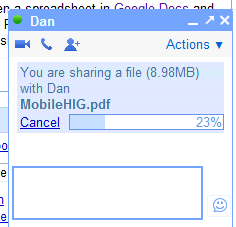
One of the few features that are available in Google Talk's desktop client, but couldn't be used in the web-based gadgets from Gmail, iGoogle and orkut, is file sharing. The missing feature is now available in iGoogle and orkut, but not yet in Gmail.

"Starting today, you can share photos, documents, and other files while chatting in iGoogle and orkut. To give it a try, just click Send a file... in the Actions menu while chatting with a friend (no download required). This feature is also compatible with the file transfer functionality in the Google Talk downloadable software, so you can share files directly from the web with folks who use the desktop version," explains Google.

You can send multiple files at the same time, but you can't select multiple files from the file picker dialog. Google Chat doesn't support transferring files larger than 100 MB.


Google Talk's desktop client is no longer updated, as Google focused on improving the chat feature from Gmail and adding similar features to iGoogle and orkut. Google Talk's homepage still links to the Windows client, but the first option is a plug-in for video chat.

{ Thanks, Niranjan. }

iGoogle Themes Explorer

iGoogle didn't make it easy to change your themes: you had to visit a separate page, find a theme, add it and then repeat the process until you found a great theme.

Now it's easier to pick a theme: click on "Change theme from [insert current theme's name]" and you'll see a small list of themes. You can select a category, sort the themes by popularity or recency and even type a query like [puppy], [flowers] or [batman] in the search box.

Social iGoogle Tested in Australia

The main reason for one of the most hated Google redesigns, the famous iGoogle update from 2008, was to transform gadgets into social web applications. The visible changes didn't make the upgrade compelling, since most users only saw a sidebar that took away some space from an already crowded homepage. Some gadgets could be maximized in a canvas view to display even more information, but not many gadgets used this opportunity in a meaningful way.


Google didn't offer an option to switch back to the classic iGoogle interface, but you can still find it if you go to http://www.google.com/ig?hl=all and in some local versions of iGoogle.

The second step of the iGoogle update is to make it more social by converting iGoogle into an OpenSocial container. That means you'll be able to add to iGoogle applications that are already available in social networks like MySpace, Orkut, LinkedIn. The main problem is that iGoogle is not a social network and the "friendship" concept is vague in the GoogleLand.

Google Australia announces that the local version of iGoogle has already added the social features:

"Starting this week, we're rolling out some new social gadgets for iGoogle to all Australian users. Not only can you continue to do all the things you love to do on your homepage, but you now have the option to share all kinds of information, play games and collaborate with your friends too. (...) Your current gadgets will continue to work normally and you don't have to take advantage of the social gadgets if you decide it doesn't fit your interest. But by adding and enabling social gadgets, you'll be able to have an even deeper, interactive experience with your gadgets when you share them with friends."

But who are these Google friends? The answer is pretty simple: the contacts from the built-in Friends group.

"Friends is a group to help you organize your contacts. You can move contacts in and out of this group at any time, and this is the only group of people who can see your updates and with whom you can share social gadgets and social gadget activities. Similarly, you can see someone else's updates or social gadget activities only if they have included you in their Friends group."

For Google, friendship is a one-way concept. You don't have to invite other people to become your friends: just add them to the built-in Friends group and they'll be able "to see what you share or do in social gadgets through the gadgets themselves, or through a new feed of information called Updates, a way to see what your friends are doing on iGoogle".

An example of social-enabled gadget is "Social Photos", which shows the latest photos uploaded to Picasa Web and Flickr by your friends.


Other examples include: the "Timeline" gadget, that lets you share what you are doing and see your friends' status messages on a timeline; puzzles and games like NY Times Crossword, chess, trivia; collaborative gadgets like ToDo List.

The features will be rolled out this week at iGoogle Australia, but you can also try them in the iGoogle Developer Sandbox. Developers can find more about iGoogle's social gadgets by visiting this page.

Yet Another Mobile iGoogle

Sometimes it's very difficult to understand Google: in 2008, Google released a great iGoogle interface optimized for iPhone, but it was discontinued one year later. "We've decided to direct iPhone users to the standard mobile iGoogle page. We've found that people hit iGoogle from lots of different phones -- we want to ensure you'll all see the same version," said a Google employee in January.

The regular mobile interface is very basic and it's only able to show feeds and a small number of gadgets. The mobile iGoogle doesn't have tabs and it's optimized for WAP phones, not for today's smartphones.

Google changed its and mind and decided to release a new iGoogle version for iPhone and Android phones. "This new version is faster and easier to use. It supports tabs as well as more of your favorite gadgets, including those built by third-party developers. (...) One of our favorite new features is the in-line display of articles for feed-based gadgets. That means you can read article summaries without leaving the page. You can also rearrange gadget order or keep your favorite gadgets open for your next visit."


To see the new version, visit iGoogle.com if you have an iPhone or an Android phone and click on "Try the new Mobile iGoogle". Google doesn't let you switch to the new version, so you need to bookmark the page. If you have a different phone with a WebKit browser, try to see if this page works well: http://www.google.com/m/ig?uipref=6.

Google Reader Gets More Social

The "What's popular" iGoogle gadget, launched last month as a simple way to discover interesting web pages, has been improved and you can now automatically add the shared items from Google Reader.

The option is disabled by default, but you can enable it in the new settings page. "Automatically submit items you share via Google Reader into the What's Popular gadget. These shares will be attributed to you. Changing this setting will only affect new shared items from Google Reader."


Google's gadget includes web pages from different sources: user-contributed pages, popular posts from Google Reader and popular videos from YouTube. You can rate the pages that you like or dislike by clicking the voting buttons displayed next to each item, much like in Digg, Reddit or Yahoo Buzz.


The gadget can be added to your personalized Google homepage, but you can also bookmark this URL. "What's popular" has less than 17,000 users, but that's probably because Google hasn't officially launched it yet.

Google Reader has an enormous amount of attention data (starred items, shared items, pages that are read or emailed), but it didn't use it to recommend popular posts, except for the "What's cool in Google Reader" feed.

{ via Blogoscoped Forum }

Import iGoogle Feeds into Google Reader

Google Reader added an option to import the feeds from iGoogle, but you'll be able to use it only the first time you load the feed reader or by opening the welcome page. I assume that Google Reader wanted to help iGoogle users who need a more powerful feed reader.

The process of importing feeds is extremely painful, since Google Reader subscribes to each feed one by one. If you only have 5-10 feeds in iGoogle, it will import the feeds quickly, but you'll need to wait a lot longer if you have more than 50 subscriptions.

You can select the feeds that should be imported and Google Reader will convert iGoogle's tabs into folders.


Last year, I wrote a script that exports iGoogle feeds to OPML, so you can import them in other feed readers. It's more difficult to use than Google Reader's feature, but at least it's efficient.

Gmail Gadget Incompatible with Secure Setting

Gmail's iGoogle gadget stopped working if you've enabled "always use HTTPS" in Gmail, a setting that redirects any Gmail URL to the secure version. "The Gmail gadget does not support the Always use https setting that you chose in full Gmail. If you would like to use https, please open full Gmail," mentions the error message.


It's worth mentioning that Google didn't enforce the option in iGoogle until now, even if the setting to force the secure connection was added last year. There are many incompatibilities between the HTTPS setting and Google applications like Google Toolbar, Gmail Notifier and the mobile Gmail application, which weren't design to support this option.

Here's Google's explanation:
As several of you have noticed, we made a change in iGoogle to the way that iGoogle's Gmail gadget works. If you previously set Gmail to only access your mail using https by selecting "Always use https" in Gmail's settings, you will now see a message in iGoogle's Gmail gadget asking you to open the full version of Gmail. We made this change in iGoogle for those users who want to ensure that their Gmail is transmitted using https.

We know that many of you would like to access your mail from iGoogle with https, and we're investigating ways to provide https support for iGoogle's Gmail gadget. In the meantime, you have a couple of choices:

- If you'd prefer to access your mail with https, please visit Gmail directly at https://mail.google.com/mail.
- If you'd rather get your Gmail on iGoogle with the Gmail gadget, visit Gmail's Settings page and select "Don't always use https."

I think it's great that Gmail supports secure connections, a feature that's not available in other popular webmail services like Hotmail and Yahoo Mail. The option to always use HTTPS is just an added bonus, since you can easily bookmark https://mail.google.com/mail/ and use that URL. To prevent the incompatibilities, Google could add independent HTTPS settings for all the applications and services that use Gmail, so that the gadget or the notifier work even if you've enabled "always use HTTPS" in the desktop version of Gmail.

{ Thanks, Simon and Michael. }

What's Popular Around the Web

Steve Rubel found a new gadget developed by Google that highlights popular content from the web. Much like Digg, Reddit or Yahoo Buzz, you can vote the web pages and add content you find interesting.


Here's how Google describes the "What's Popular" gadget:
The What's Popular gadget by Google helps you discover interesting items from all over the Internet.

How we find interesting stuff
What's Popular uses algorithms to find interesting content from a combination of your submissions and trends in aggregated user activity across a variety of Google services, like YouTube and Google Reader.

Ratings
You can rate items that you like or dislike by clicking the ratings buttons next to each item. If you change your mind, you can change your rating at anytime. The What's Popular gadget looks at what users liked or disliked to improve its ranking of interesting items.

Add a URL
Tell What's Popular about interesting items you have found! If they become popular, they may rise to the top of our list! You can submit an item with or without attribution to yourself and preview your submission before you post. If you decide to associate your username with your submission you'll be able to edit its title and description. The items you submitted can be found in the "My adds" area, where you can remove your name if you change your mind.

The gadget is a part of a service that will be released in Google Labs, where it's already hosted. Right now, the most popular web page has 13 pops (probably a name for upvotes), there are three categories: stories, videos, images and the pages are sorted by relevancy, the algorithm favoring recent content.

iGoogle Theme Creator

One week ago, Google Blog announced an official tool for building themes for iGoogle. "Now, you too can capture memories and images on your iGoogle homepage by building a custom theme. We've just released our new tool for creating iGoogle themes. It's an easy way for iGoogle users to spruce up their personalized homepage without needing to know how to use XML, etc. All you need is an image, and we'll provide the rest."

The idea is great as people will always like to see a personal photo on their homepage. As usually, iGoogle managed to make another mistake: the theme creator page has been down until today.

Now that it's finally available, you can see the tool is very basic and it only lets you upload an image, choose a header text color and a theme color. It's very difficult to crop a photo so that a certain region is visible, the color palette doesn't include too many options, you can't find the themes you've created to apply them to other pages and you need to accept a license agreement after creating a new theme.


If you need more control, try the two advanced editor previously mentioned or create your own XML files using iGoogle's API.

{ via Blogoscoped }

iGoogle Redirects iPhone Users to the Standard Mobile Interface

iGoogle continues to make mistakes. After testing the new version of iGoogle without providing an option to end the experiment, after ignoring most of the complaints regarding the new interface, Google decided to redirect iPhone users to the standard mobile interface, instead of sending them to the iPhone-optimized interface. Apparently, G1 users were also affected by this strange decision.

"We've decided to direct iPhone users to the standard mobile iGoogle page. We've found that people hit iGoogle from lots of different phones -- we want to ensure you'll all see the same version. Most or all of your existing content should translate over to the standard mobile version. The only exception would be any gadgets that aren't compatible with most mobile browsers," explains a Google engineer.

The problem was that the iPhone-optimized interface included all the gadgets from the desktop version and the tabs, it was sleek and easy to use on a touch screen, while the standard mobile version only shows feeds and a small number of gadgets. Degrading user experience and taking away a lovely interface is not the best way to encourage people to use iGoogle.

iGoogle's forum has a long thread with complaints and some users suggest to change the user-agent in Safari because the iPhone interface is still available for other browsers. Here's one of the few polite messages from the thread:

"I have to admit I am quite surprised by the unofficial news that you have removed your previously excellent iGoogle adaptation for iPhone. I can understand that in times of consolidating services in order to increase your internal efficiency you need to keep down the number of platforms. But removing the iPhone support without properly notifying your users in advance and explaining the reasons why you do this is perhaps not the smartest move if you want to keep loyal customers and brand value. And especially since you yourself have found that iPhone users are very active web users compared to the other mobile platforms."

How to Remove iGoogle's Chat Box

Update: This trick is no longer necessary since there's an option that lets you hide the chat box. To hide the chat box, click on the "Options" link next to the contacts list and select "Hide chat".

iGoogle added a Google Chat box in the sidebar, but many people find it annoying because they don't use the option and it slows down page loading. Google doesn't provide an option to hide the chat box, but someone found a workaround that disables it.


If you haven't set up mobile iGoogle, use the wizard from this page. Then go to the settings page, scroll down to the Export/Import section, click on the Export button and save an XML file that contains the settings for all the iGoogle tabs. Open the file in a text editor like Notepad, find the last line that contains <Section/> and remove it. After saving the file, go back to iGoogle's settings page and upload the XML file.

Google Chat in iGoogle and orkut

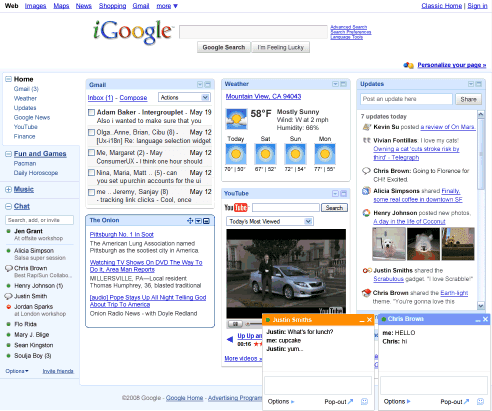
Google started to integrate a Gmail Chat widget in iGoogle's much-hated navigation sidebar. The page will load even slower and people will have one more reason to complain. If you don't like the chat box, Google recommends to sign out of chat, although you could also change your status to "invisible".

Another thing you'll notice in all versions of iGoogle is the integration of Google Suggest in the search box. As usually, this can be disabled in the preferences page by selecting "Do not provide query suggestions in the search box".

Preparing to become a full-fledged social site, iGoogle added a contact manager to the settings page so you can separate your contacts and view their profiles.


If these new features aren't yet enabled in your account, visit http://www.google.com/ig/v2invite to add them. For those who hate everything about the new iGoogle, from the unfinished Gmail gadget to the big sidebar and the annoying bug that displays the canvas view of the most recently opened gadget when you open iGoogle, there's an address that shows the old version of iGoogle: http://www.google.com/ig?gl=all.

orkut, the other social network owned by Google, continues to add last season's Facebook features, now cleverly integrating Gmail Chat. "To get you started, we've come up with a formula that automatically predicts which of your orkut friends you probably want to chat with, and only tells those people that you're signed into Google Talk. Our formula takes a bunch of things into consideration, giving preference to people who you've labeled as 'best friends' or written scraps to recently, and people who have friends in common with you."

In addition to showing Google Talk contacts, orkut will also add some friends you are likely to chat with. Like iGoogle's sidebar chat, orkut's chat boxes are persistent so you can visit different orkut pages while continuing to chat.

The new orkut feature will be rolled out in the next weeks to orkut's huge userbase, so it's likely that you won't see it right away.


{ Thanks, Edam. }

The New iGoogle, Publicly Launched

After months of painful testing, the new version of iGoogle has been launched for everyone in the US. iGoogle 2.0 moves the tabs to the left, brings a persistent Google Chat widget and it adds a canvas view that allows gadgets to become full-fledged applications.

"Canvas view allows developers to deliver richer content, games, and UI to users on iGoogle as well as the opportunity to monetize," explains Google. Not all the gadgets take advantage of the canvas view, but this page highlights some gadgets that can be maximized and the list includes: Google Reader, Google Calendar, Gmail, weather, Wall Street Journal and regular feeds. For example, the new Gmail gadget lets you read your messages and send replies directly from iGoogle, but it lacks some features that would've made it a good replacement for the full-featured Gmail: links and attachments are stripped from messages.

Google has been testing the new version of iGoogle for the past three months on a small sample of users and many of them complained about the new navigation interface.


"We're very excited about these changes because it makes iGoogle a more useful homepage and a better platform for developers. And this is just the beginning: expect to see more canvas gadgets created by developers and more new features on iGoogle soon. Not in the U.S.? Don't worry. We'll also be rolling out this updated version in other countries very soon," mentions Google's blog.

The next big thing for iGoogle is the support for OpenSocial that will make Google's personalized homepage more social.

Update: For those who don't have the new iGoogle yet, go to the settings page, change the language to English (US) and then go to this URL: http://www.google.com/ig/v2invite.

If you have the new version, but you prefer the previous interface, go to the settings page and select English (UK) from the list of languages. Please note that this is just a temporary fix.


{ Thanks, Pascal, Samuel, Chrissz and everyone who commented. }

Popular Names for iGoogle Tabs

iGoogle has a very cool feature that populates tabs with gadgets and feeds just by entering a title. When you create a tab, there's an option called "I'm feeling lucky. Automatically add stuff based on the tab name".

To make things even easier, iGoogle started to suggest popular names sorted by the number of users. There are 227,300 users that have tab named "Lifestyle", 3,725,200 users that named a tab "Music" and 21,070,090 users that couldn't find a better name than "Home".


Here's the top 10 for English:

1. Home - 21,070,090 users
2. News - 6,755,900
3. Games - 4,103,500
4. Entertainment - 4,002,300
5. Music - 3,725,200
6. Humor - 3,712,500
7. Sports - 3,667,300
8. Technology - 3,016,700
9. Cooking - 2,203,700
10. Politics - 2,170,700
.....
?. Name this tab - 490,000

and the top 10 for French:

1. Accueil - 1,757,000 (Home)
2. Actualités - 590,100 (News)
3. Dictionnaire - 375,100 (Dictionary)
4. Google - 371,300
5. Musique - 346,100 (Music)
6. Jeux - 297,800 (Games)
7. Informatique - 291,600 (IT)
8. Photos - 282,700
9. Culture - 242,600
10. Radio - 237,700

For other languages, use this URL:
http://www.google.com/ig/mtjson?hl=LANG_CODE&q=
and replace LANG_CODE with a language code supported by iGoogle.

The iGoogle Experiment

iGoogle Developer Blog announces developers that the experimental version of iGoogle is a success and that more users will be a part of the experiment.

"It's been a few weeks since I've provided an update on the status of the canvas view launch. Our experiments with a small percentage of users have been going well, and we've been making some small changes and adjustments based on user feedback (such as reducing the width of the left nav). In the next few weeks we plan on ramping up the number of US English users with the canvas view."

Canvas view is one of the features from a major update for iGoogle that will bring support for OpenSocial gadgets, activity streams and more social apps. The trouble is that Google randomly selected a list of users to join the experiment, without providing a way to opt-out*. Most people didn't understand the implications of the update and only noticed the new design (the horizontal tabs have been replaced by a vertical menu), the missing functionality (you can't move a gadget to a different tab) and the broken gadgets (Gmail's canvas view displays the messages inside iGoogle, but it doesn't have a reply button).


Some people complained in iGoogle's discussion board, but Google didn't admit its mistake and continued to expand the experiment. Here's an interesting comment from a user:

"Your methodology is very heavy-handed. I am a retired executive from the old-days of computing (IBM and the BUNCH). We could never have imagined changing the interface of our customer's tools without asking permission. In many cases, we would have to support old versions of software for years after we thought we had newer and better products, just because our customers had gotten used to the way the old versions worked and had modified their habits to accommodate us. It would be considered the highest form of arrogance to force changes on them without their permission. Part of the wrath you are hearing from your users is because of your methodology, and the fact that it's way too hard to give you feedback."

Things have changed and web applications update much faster, often without providing an option to revert to a previous version. But it's extremely arrogant to replace a working version of a popular application like iGoogle with an unfinished version, without providing a way to opt-out. iGoogle was supposed to be a personalized Google homepage, a place where you can choose your favorite gadgets, feeds, themes.

When Flickr started to test a new interface for the dashboard, it placed a small link: "Would you like to try a new version of this page?". FriendFeed used a different address to test a new design and improve it based on the feedback. Gmail still links to the "classic" version to test how many people are satisfied with the new one. But iGoogle decided to try a different path and many unhappy users migrated to My Yahoo, Netvibes or other similar services.

"Our experiments with a small percentage of users have been going well, and we've been making some small changes and adjustments based on user feedback (such as reducing the width of the left nav). In the next few weeks we plan on ramping up the number of US English users with the canvas view."

* Some users managed to revert to the classic interface by going to google.com/ig and pasting in the address bar:
javascript:_dlsetp('v2=0')
Related Posts Plugin for WordPress, Blogger...